
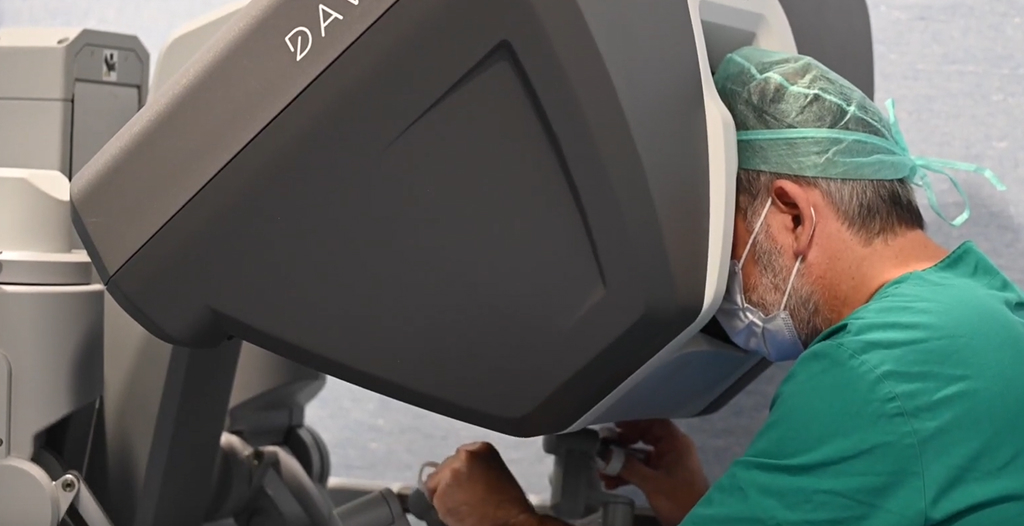
Dr. Gonzalo Sanz Pérez talks to us about Da Vinci robotic surgery for prostate cancer.
Frequently Asked Questions
Who is the ideal patient for prostate cancer surgery with the Da Vinci system?
Any man who has prostate cancer in its early stages.
Who will operate on me, a surgeon or a robot?
A surgeon assisted by a robot. The da Vinci does not operate autonomously, but rather replicates the surgeon's movements and obeys their commands while enhancing the surgeon's vision, precision, and dexterity.
Does this procedure have risks?
Like any other surgery, it can present some complications (bleeding, infection, reaction to anesthesia, etc.). However, thanks to its advanced technology and the fact that it is a minimally invasive procedure, these risks are less likely.
How does robotic surgery differ from laparoscopic surgery?
In laparoscopic surgery, the surgeon operates manually with rigid instruments and observes the area to be operated on through a standard two-dimensional video monitor. Both of these factors can cause vision and dexterity problems during the procedure. With the da Vinci robot, the surgeon has 360º visibility of the prostate with high magnification capabilities for greater precision. Furthermore, it allows the surgeon to make incisions and movements with millimeter precision thanks to the ability to mechanically and digitally augment the specialist's movements. Essentially, the da Vinci robot performs surgical maneuvers with greater accuracy, reduces the procedure time, minimizes invasiveness, and further enhances the reliability of the treatment.
Advantages of having surgery with the Da Vinci robot
Greater precision for the surgeon, better results for the patient
•Safer: The risks of conventional open surgeries and potential human errors are minimized thanks to the safety systems implemented in the processor.
•Less invasive: By making small incisions through which the robot's surgical arms operate, there are fewer postoperative complications, less pain, less scarring, and less bleeding.
•Better recovery: Because it is a minimally invasive procedure, recovery is faster and the hospital stay is shorter than when an open radical prostatectomy is performed.
•More precise: In addition to facilitating intervention in areas difficult for the surgeon to access, the high magnification capacity provided by the console offers perfect three-dimensional visibility so that the surgeon can make incisions in microsurgery, something almost impossible in laparoscopic or open surgeries.
•Faster: The hospital stay is reduced. The patient can leave the hospital 4-5 days after the procedure, compared to 10 days of hospitalization for conventional operations.
•Better prognosis in preserving erectile potency and urinary continence: The rate of preservation of urinary continence is over 90%, provided the prostate condition allows it, while the recovery of erection is also preserved in a large number of cases, provided the nerves responsible for erection can be preserved and the patient's previous condition is suitable.