
We answer some of the most common questions about urological consultations, tests, and treatments.
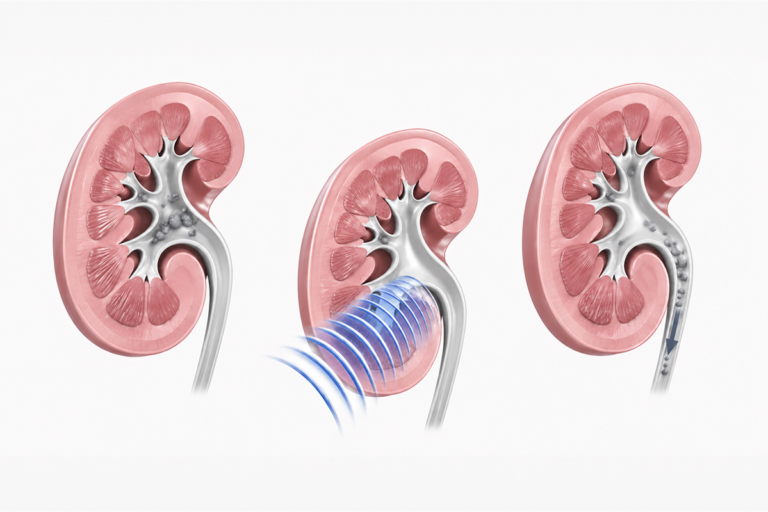
Not all kidney stones can be treated with extracorporeal shock wave lithotripsy (ESWL). The choice depends primarily on the size, location, and hardness of the stone. Small or medium-sized stones usually respond better to this treatment, while large or difficult-to-access stones may require other techniques or laser treatments.
ESWL is performed by urology specialists experienced in treating urinary stones. The procedure uses imaging technology to precisely locate the stone and safely and effectively target the shock waves.
No. Extracorporeal shock wave lithotripsy (ESWL) is an outpatient procedure that generally does not require hospitalization. After the session and a short period of observation, the patient can return home the same day.
Recovery is usually quick, and most patients resume their normal activities within 24 to 48 hours after treatment. It is normal to pass small fragments of the stone in the urine for several days afterward.
External lithotripsy is a safe and well-tolerated technique. Mild discomfort or the passage of fragments in the urine may occur for a few days after the procedure. The specialist will assess each case to minimize risks and ensure the most appropriate treatment.
The main advantage of extracorporeal shock wave lithotripsy (ESWL) is that it does not require inserting instruments into the urinary tract or making incisions. In contrast, holmium laser and thulium laser treatments are minimally invasive techniques that require accessing the urinary tract with specialized instruments to fragment the stone.
The treatment is performed using state-of-the-art equipment from Dornier, a world leader in lithotripsy. In addition, the center also has advanced technology such as holmium and thulium lasers to offer the most appropriate therapeutic option based on each patient's individual needs.
See more frequently asked questions