
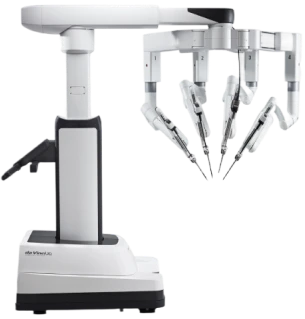
Robotic surgery for prostate cancer with the Da Vinci system

Robotic surgery with the Da Vinci system is the most advanced technique for treating prostate cancer through minimally invasive radical prostatectomy. This procedure allows for the complete removal of the prostate with millimeter precision, reducing the impact on surrounding tissues and significantly improving patient recovery.

Prostate cancer detection

Prostate cancer is the most common tumor in men and the second leading cause of cancer death in men. It develops when tumor cells grow in the prostate and can spread to other organs. When detected in its early stages, without metastasis, radical prostatectomy allows for the complete removal of the tumor. The prostate is a gland in the male reproductive system responsible for producing part of the seminal fluid. After age 45, the risk of developing prostate diseases increases, making it essential to have regular checkups with tests such as the PSA test, digital rectal exam, or IPSS test.

From age 45

Annual review recommended
• PSA Analysis
• Urological Ultrasound
• IPSS Test

Who is this surgery suitable for?

This surgery is indicated for men with localized prostate cancer, meaning at a stage where the tumor has not spread beyond the prostate gland. In these cases, the surgery has a curative aim.

Most diagnoses occur in patients over 65 years of age, with an average age of around 75. Therefore, early detection through regular urological checkups is key to being eligible for this type of intervention.

Types of surgery: radical prostatectomy

Radical prostatectomy involves the removal of the prostate gland along with the seminal vesicles, vas deferens, and sometimes nearby lymph nodes. There are different ways to perform this surgery, which have evolved into increasingly less invasive techniques:
1
Open radical prostatectomy
It requires a large incision in the abdomen, with greater surgical aggressiveness and a slower recovery.
2
Perineal radical prostatectomy
It is performed through an incision between the anus and the scrotum. It is faster, but may present more functional complications.
3
3D robotic prostatectomy
It is the most advanced and least invasive technique. It improves the surgeon's precision, optimizes results, and reduces the impact of the procedure.

How robotic surgery is performed with Da Vinci

1
The intervention

It is performed under general anesthesia and lasts approximately two to three hours. The medical team consists of an anesthesiologist, two surgeons—one of whom operates the robotic console—and specialized nursing staff.

2
The procedure

It begins with making small incisions in the abdomen, through which surgical instruments and a high-definition 3D camera are inserted. To improve visibility and facilitate work within the pelvic cavity, carbon dioxide is insufflated.

3
The surgeon

He controls the robotic arms from a console, allowing him to perform 360° movements with a precision impossible for the human hand. Thanks to this technology, the prostate can be removed while minimizing damage to the nerves responsible for urinary continence and erectile function.

4
Postoperative

Once the procedure is complete, the urethra is reconnected and a catheter is inserted, which will remain in place for approximately one week to promote proper healing. The patient is then transferred to recovery, and may spend the first night in the ICU for closer monitoring.

Results, benefits and advantages

Robotic surgery with the Da Vinci system represents a significant advance over traditional techniques, both in terms of safety and functional results.
Surgical precision
Safer and more controlled interventions
Less invasion
Small incisions, less impact on tissues
Less pain
It reduces pain and bleeding during surgery.
Fewer complications
Post-operative risks are reduced
Rapid recovery
Shorter hospital stay (4–5 days)
Better aesthetic result
Smaller and less visible scars

Areas of specialization

FAQ

We answer some of the most common questions about urological consultations, tests, and treatments.

The ideal candidate is a man with early-stage prostate cancer, without spread to other organs, since in these cases radical prostatectomy can completely remove the tumor.

The surgery is performed by a specialized surgeon assisted by the Da Vinci robot. The system does not operate autonomously, but rather replicates the surgeon's movements, improving their precision, vision, and control capabilities.

The patient typically remains hospitalized for about four days and continues recovery at home following medical instructions. They will have a catheter in place for approximately one week, which will be removed during a follow-up appointment.

Urinary continence typically returns gradually over the following weeks, usually within three months. Erectile function can recover in a matter of weeks or take up to two years, depending on the individual patient.

It is recommended to avoid sexual relations during the first month and the return to work usually occurs after four weeks, or six in the case of physical work.

As with any major surgery, there are risks such as reactions to anesthesia, bleeding, infection, or blood clots. However, because it is a minimally invasive technique, these risks are lower than in open surgery.

The most common side effects include urinary incontinence, erectile dysfunction, and changes in orgasm, which may become dry after the procedure. These effects usually improve over time, although their progression varies from patient to patient.

 Unlike laparoscopy, robotic surgery offers high-definition, three-dimensional vision and much more precise movement capabilities. This allows the surgeon to work with greater accuracy in complex areas, improving outcomes and reducing the impact of the procedure.

  • Robotic radical prostatectomy
  • Robotic prostatectomy combined with other procedures
  • Robotic radical nephrectomy
  • Robotic partial nephrectomy
  • Nephrectomy with lymphadenectomy
  • Robotic nephroureterectomy
  • Robotic radical cystectomy
  • Cystectomy with lymphadenectomy
  • Radical cystectomy with intracorporeal urinary diversion
  • Robotic supraadrenalectomy
  • Robotic pyeloplasty
  • Ureteral reimplantation (ureterocystoneostomy)
  • Robotic unilateral ureterocystoneostomy
  • Laparoscopic cutaneous ureteroileostomy

See more frequently asked questions

Learn more about the process

Da Vinci Surgical System

Beneficios de la cirugía robótica para cáncer de próstata

Dr. Sanz & Da Vinci robot

El Dr Sanz explica la cirugía de próstata con robot Da Vinci

Dr. Sanz and colleagues with Da Vinci